
2024: Texas A&M
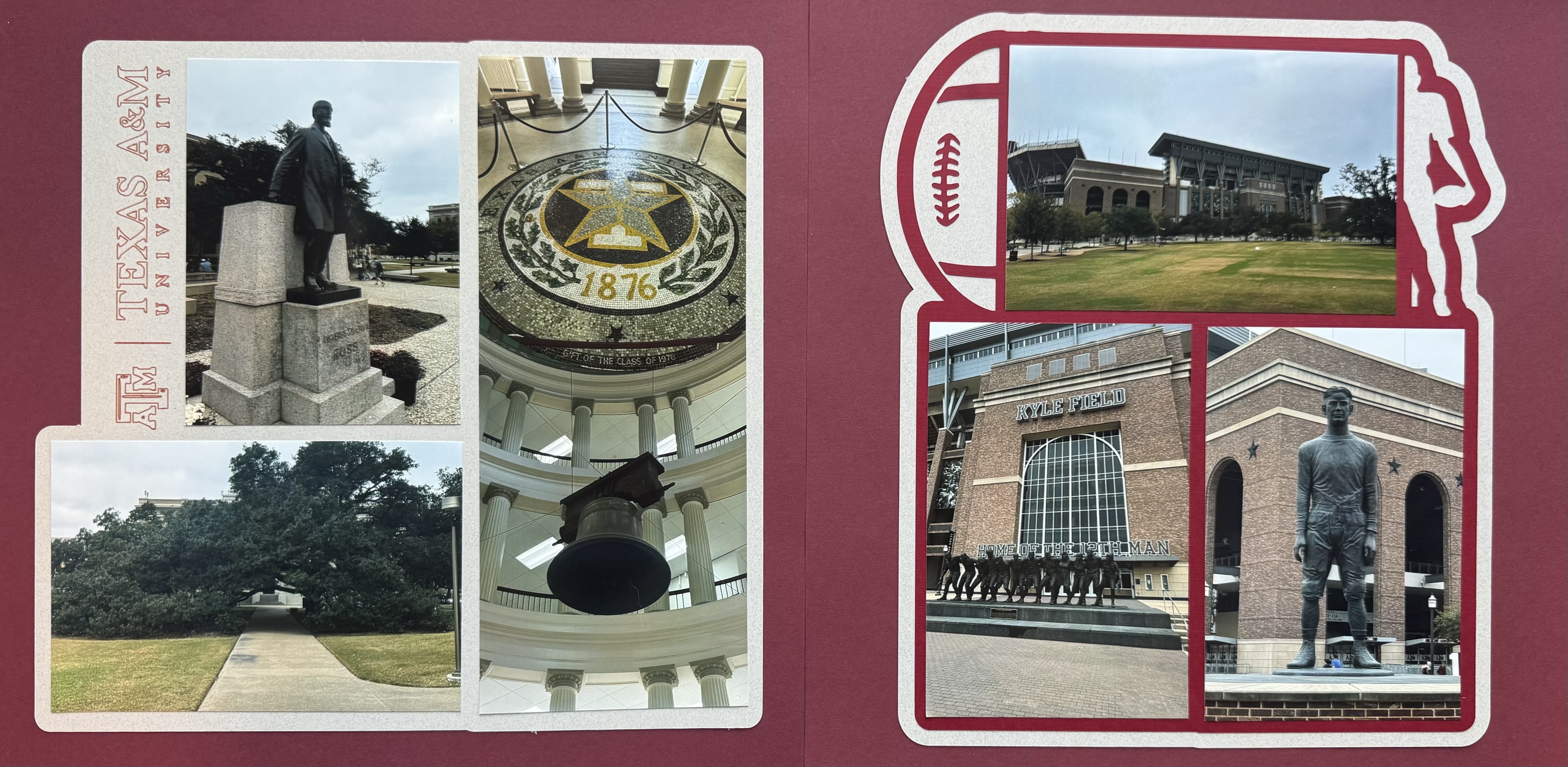
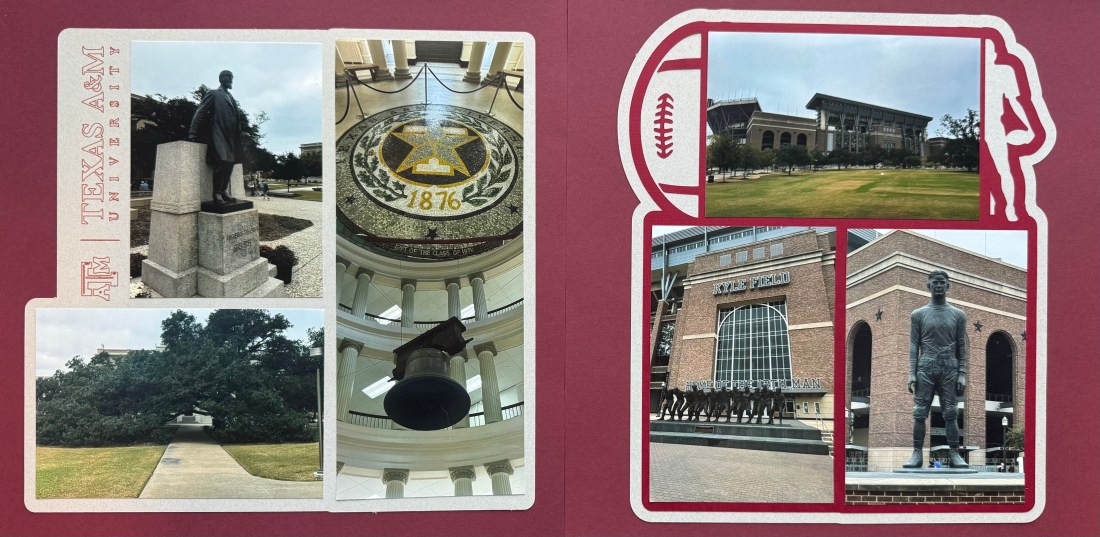
One of the most memorable trips I ever took with students from McLennan Community College was a transfer-student tour to Texas A&M University in College Station. This scrapbook spread honors some of the photos I captured that day — and the stories behind them.
Why Texas A&M & Why Maroon
I chose maroon as the dominant color for this layout because it echoes the very soul of Texas A&M. Their school colors — maroon and white — are worn with pride by students, alumni, and fans at every event. The maroon backdrop gives the spread unity, strength, and a sense of belonging to “Aggieland.”
Texas A&M, founded in 1876 as the Agricultural and Mechanical College of Texas, has grown into a flagship public research university. It’s known for its deeply rooted traditions, strong alumni network, and a campus culture steeped in loyalty and service.
We were there on Ring Ceremony Day, a special event at A&M when students officially receive their Aggie Ring. This ring is not just a piece of jewelry — it symbolizes the hard work, commitment, and shared identity of Texas A&M students. Attending Ring Ceremony Day was a special opportunity — to see pride, emotion, and community in action. Including that moment in this scrapbook spread helps anchor the trip in both heart and tradition.
Left Page: Campus Tour, Tree, Bell & Mosaic
On the left-hand page, you’ll see:
- The Texas A&M institutional logo, cut and drawn using my Cricut machine (Cricket Design Space made it easy to create precise designs).
- Photos from our campus walking tour: the architectural lines of academic buildings, the mosaic flooring in an open hall, and a hanging, layered image of the Liberty Bell replica.
- The lower section features a tree — not just any tree, but the Century Tree, a storied landmark at A&M.
The Century Tree Tradition
The Century Tree is a massive live oak located between the Academic Building and Bolton Hall on A&M’s campus. According to tradition, If two lovers walk beneath its drooping branches, they will, in due time, be married. If a proposal happens under the tree, the marriage is believed to last forever.
Because of those legends, it’s sometimes called A&M’s “sweetheart tree.” Many couples pick that spot for romantic, symbolic moments.
In my layout, I inverted the usual order (floor/mosaic on bottom, Liberty Bell on top) to follow the gentle arc and colonnades in the photos. The result is a flowing visual path that echoes how we walked through those spaces.
Right Page: Stadium & The 12th Man
The right-hand page is dedicated to two iconic Aggie moments:
- Photos of Kyle Field, the unmistakable home of Aggie football.
- A statue that celebrates the 12th Man tradition — a powerful symbol of unity and readiness.
The 12th Man Tradition
Texas A&M’s “12th Man” concept originates from E. King Gill in 1922. At that time, A&M’s football team had exhausted its roster during a game, and Coach Dana X. Bible called up Gill — then sitting in the stands — to ready himself should he be needed. Gill put on a uniform and stood on the sideline, prepared to play.
From that moment, the idea developed that the student body is, in spirit, the “12th Man” — always ready to support, serve, and jump in if needed. Today, students stand during games to symbolize that readiness and solidarity.
In 1980, the Class of 1980 funded a bronze statue of Gill to commemorate that legacy. In the ’80s, coaches also created a 12th Man Kickoff Team composed of dedicated walk-on players — often students — to extend the tradition in competition. Over time, rules evolved; now, typically a single walk-on wearing the number 12 participates in special teams plays. The 12th Man isn’t just about football — it’s woven into the identity of every Aggie, representing community, service, and willingness to answer the call.
If you are interested in seeing more about how this spread was put together click on the video below:
 MASCrapping