
Masculine Scrapbooking with AI: Finding Alternatives to Flowers and Glitter
AI in the Scrapbook Room: Article 13
When I started exploring scrapbooking, one of the things that struck me was how much of the available merchandise seemed designed around a particular style. Flowers, ribbons, lace, pastel colors, decorative flourishes, and glitter were everywhere. There’s absolutely nothing wrong with any of those things, but they weren’t necessarily what I wanted to use when telling my stories.
That’s one of the reasons I started Masculine Scrapping. I wanted to explore a different approach to scrapbook design, one that reflected my interests, experiences, and personal style.
Over the years, I’ve discovered that masculine scrapbooking doesn’t have to mean dark colors, camouflage, gears, or sports themes. I’ve created pages about travel, architecture, food, family celebrations, historical landmarks, and all sorts of other experiences. Each project presents an opportunity to develop something different.
And that’s where ChatGPT can be particularly helpful.
In previous articles in my AI in the Scrapbook Room series, we’ve explored using AI to select photographs, brainstorm layouts, create titles, and develop coordinated double-page spreads. In this article, I want to focus on something a little different: using ChatGPT to expand the creative possibilities of masculine scrapbook design.
We’re going to explore three approaches: finding alternatives to traditional embellishments, experimenting with different masculine design styles, and transforming an existing layout.
I’ve included a video at the bottom of this article demonstrating all three techniques. You can watch it straight through or pause at each section to experiment with the prompts yourself.
Step 1: Finding Alternatives to Traditional Scrapbook Embellishments
One of the challenges of masculine scrapbooking is figuring out what to use in place of some of the more traditional decorative elements. Think about how often flowers, ribbons, lace, and flourishes appear in scrapbook designs. These elements aren’t necessarily there because the subject calls for them. They’re frequently used because they help fill empty spaces, frame photographs, create borders, or add visual interest. That’s an important distinction. If I remove a floral border from a scrapbook layout, I still need to consider what that border was accomplishing. Was it helping connect two photographs? Was it defining the edge of the page? Was it simply adding another layer of color?
Instead of asking ChatGPT to eliminate those elements, I can ask it to suggest alternatives that accomplish the same purpose.
Prompt 1: Finding alternative embellishments
I’m creating masculine scrapbook pages and want to explore alternatives to traditional embellishments such as flowers, ribbons, lace, glitter, and decorative flourishes. Suggest creative alternatives that accomplish the same design purposes, including framing photographs, creating borders, filling empty spaces, adding texture, and connecting different parts of a layout. Don’t limit your suggestions to stereotypically masculine imagery such as gears, tools, or sports equipment. Include geometric shapes, architectural elements, typography, natural forms, and other creative possibilities. Organize your suggestions by the design purpose they serve, and explain how each alternative could be used on a scrapbook page.
I particularly like asking ChatGPT to organize its suggestions by design purpose. That makes the results more useful than simply receiving a long list of masculine-themed objects. For example, instead of a decorative ribbon running across a page, I might use a wide strip of cardstock with a geometric edge. A floral corner embellishment might be replaced by overlapping shapes or a simple architectural detail. A decorative flourish might become a series of lines or a bold silhouette.
And I don’t necessarily have to replace every decorative element. Sometimes the strongest design is the one that leaves more space around the photographs.
Once ChatGPT has suggested some alternatives, I can ask it to create visual examples of the ideas that interest me. For instance, I might follow up with, “Show me three different ways to use geometric shapes as decorative corners on a masculine scrapbook page. Keep the designs simple enough to cut from cardstock.” That turns a general brainstorming exercise into something I can actually visualize.
The important lesson here is that we’re not just removing flowers and glitter. We’re thinking about why decorative elements are used and finding other ways to accomplish the same goals.
Step 2: Exploring Different Masculine Design Aesthetics
One of the things I want to avoid with masculine scrapbooking is creating another set of rules about what scrapbook pages are supposed to look like. There’s no reason every masculine scrapbook page needs to use black, brown, or navy. There’s also no reason every page needs distressed paper, metal embellishments, or rugged textures. A masculine scrapbook page can be colorful, elegant, playful, minimalist, dramatic, or sophisticated. Much depends on the photographs and the story being told.
I think ChatGPT can be particularly useful for exploring these different approaches because it can generate visual examples that help us compare styles.
For this demonstration, I’m going to ask ChatGPT to create several different interpretations of a masculine scrapbook design.
Prompt 2: Exploring masculine design styles
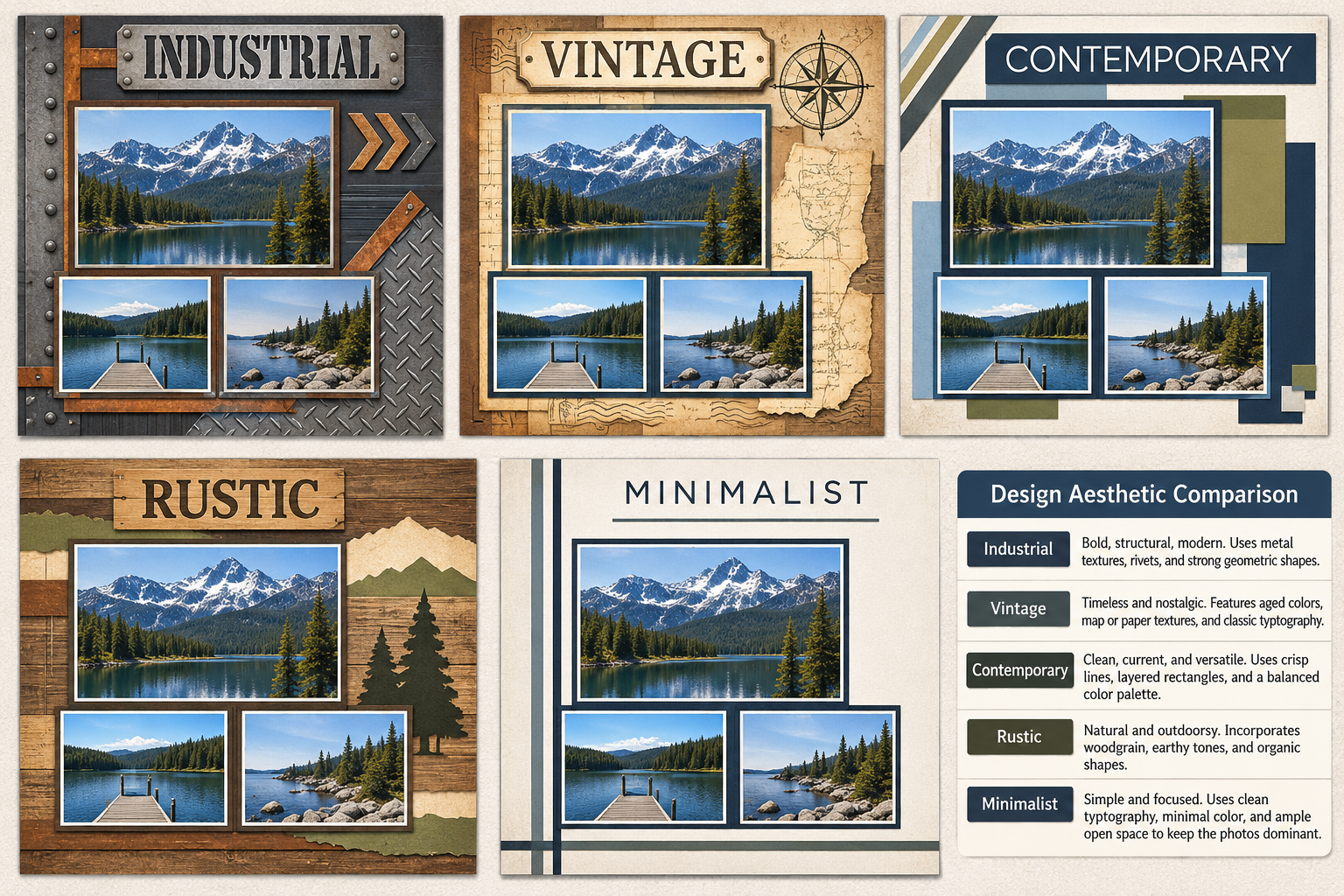
Create a visual comparison of five different masculine scrapbook design aesthetics: industrial, vintage, contemporary, rustic, and minimalist. Use the same basic scrapbook page arrangement for each example so I can compare the differences in style rather than differences in photograph placement. Show how each aesthetic uses color, typography, shapes, textures, and decorative elements. Avoid stereotypical masculine decorations unless they genuinely fit the style. Make the examples appropriate for a 12×12-inch scrapbook page, with photographs as the primary focus. I want actual visual examples, not just written descriptions.
What I hope to see is how differently the same basic layout can feel depending on the design choices. An industrial approach might incorporate strong lines, concrete-like textures, or architectural shapes. A vintage design might use aged paper colors and traditional typography. A contemporary layout could use bold color blocks and clean geometric elements. A rustic design might incorporate natural textures and earthy colors, while a minimalist approach could rely on generous open space and carefully positioned photographs. None of these styles is inherently better than the others. What interests me is how they provide different ways to approach a scrapbook project. For example below is the ChatGPT output to the prompt above. And this doesn’t have to be the end of the process.
I might see a color combination in one example that I particularly like, but prefer the typography from another. I can then ask ChatGPT to explore a combination of those elements.
For example, I might say, “I like the clean arrangement of the minimalist design, but I prefer the colors and textures of the rustic example. Show me what a combination of those two styles might look like.”
This is where AI becomes more than a source of ready-made designs. It becomes a way to experiment with visual ideas before committing to a particular direction.
I also think this exercise can help us recognize our own design preferences. We may discover that we’re consistently drawn to particular shapes, color relationships, or types of typography, even when the subjects of our scrapbook pages are very different.
Step 3: Transforming an Existing Scrapbook Layout
For our third demonstration, I want to try something a little more practical.
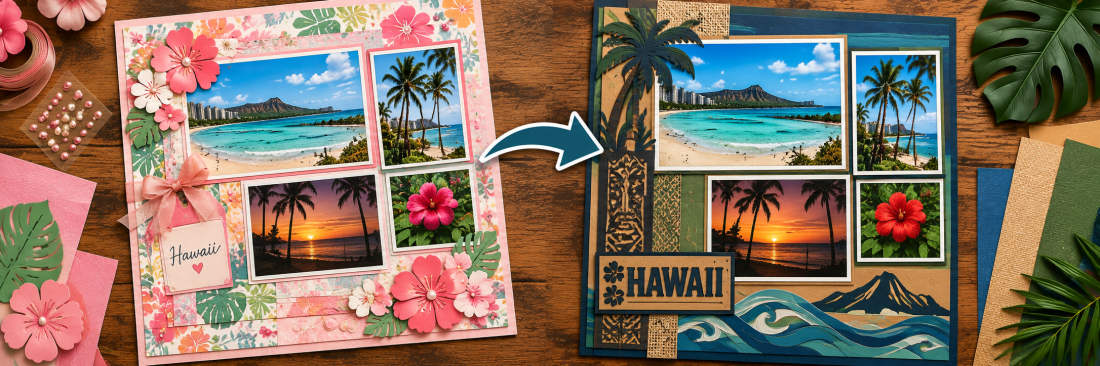
Let’s start with one of my existing scrapbook layout that uses a fairly traditional decorative style. It includes floral embellishments and feminine colors that I chose mostly because I wanted to use the background paper. While it looks good – it could have been designed to be more masculine.
Rather than changing the entire composition, I want to see how ChatGPT can reinterpret the design while preserving the arrangement of the photographs. This is an interesting exercise because it separates two parts of scrapbook design that we sometimes think of as one: the underlying layout and the decorative style.
A layout might have an excellent arrangement of photographs, even if the embellishments don’t appeal to me. There’s no reason I can’t learn from the composition while developing a completely different visual treatment.
For this demonstration, I’ll upload an image of this existing scrapbook layout and ask ChatGPT to create several alternatives.
Prompt 3: Transforming an existing layout
I’m uploading an image of an existing scrapbook layout. I like the overall arrangement of the photographs, but I want to explore how the design could be reimagined for masculine scrapbooking. Preserve the photograph positions, sizes, and general composition. Replace the traditional decorative elements with alternatives that create a different visual character. Generate three distinct visual interpretations: one contemporary, one vintage-inspired, and one bold geometric design. Keep the photographs as the focus, and use embellishments that could reasonably be recreated with cardstock and a Cricut. Don’t simply replace flowers with gears or other stereotypically masculine objects. Show me the three redesigned layouts so I can compare them visually.
What I particularly like about this exercise is that it demonstrates how much of a scrapbook page’s character comes from the design elements surrounding the photographs. We might keep exactly the same photograph arrangement but change the background colors, borders, typography, and embellishments. The result could feel like an entirely different scrapbook page. Below are the three outputs from this ChatGPT prompt.
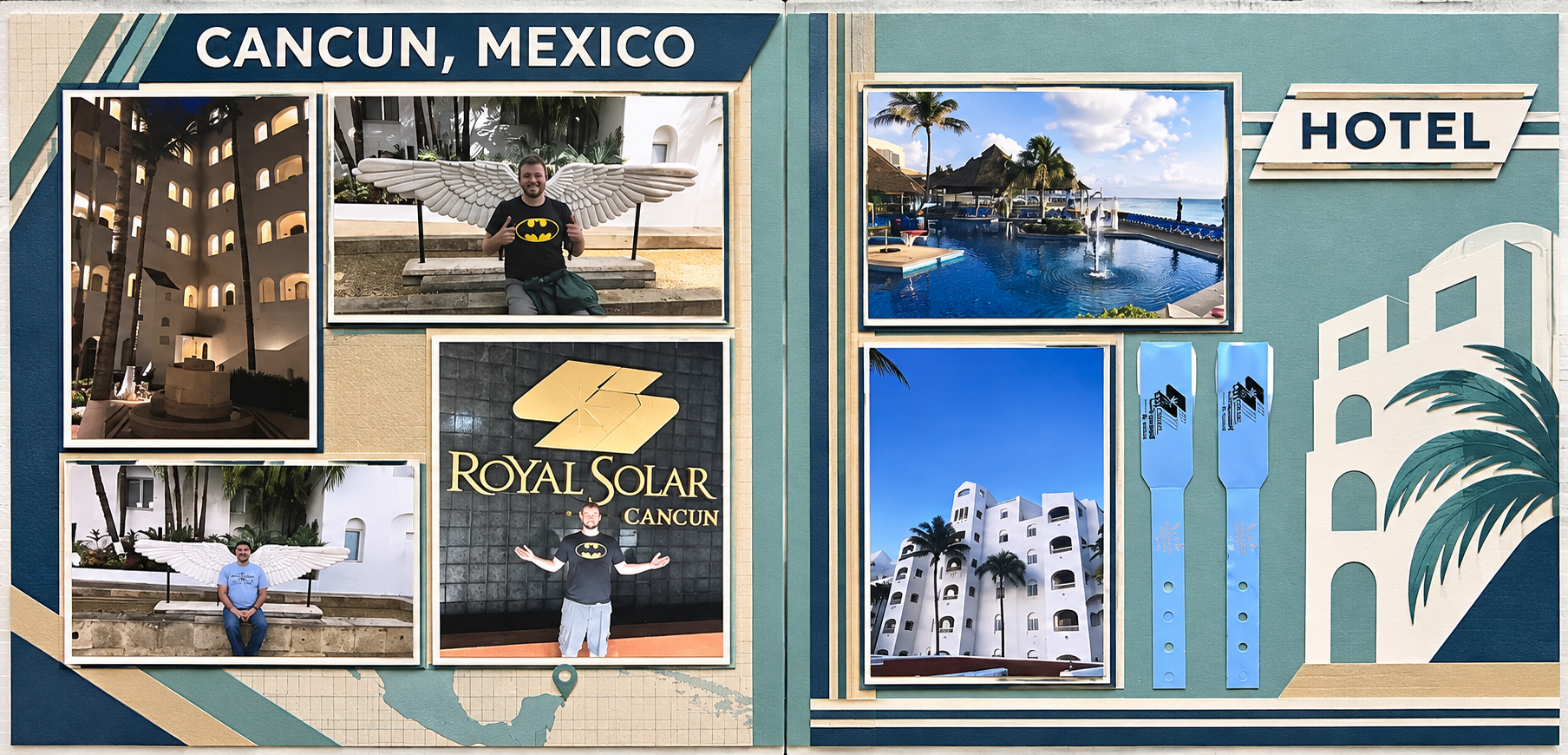
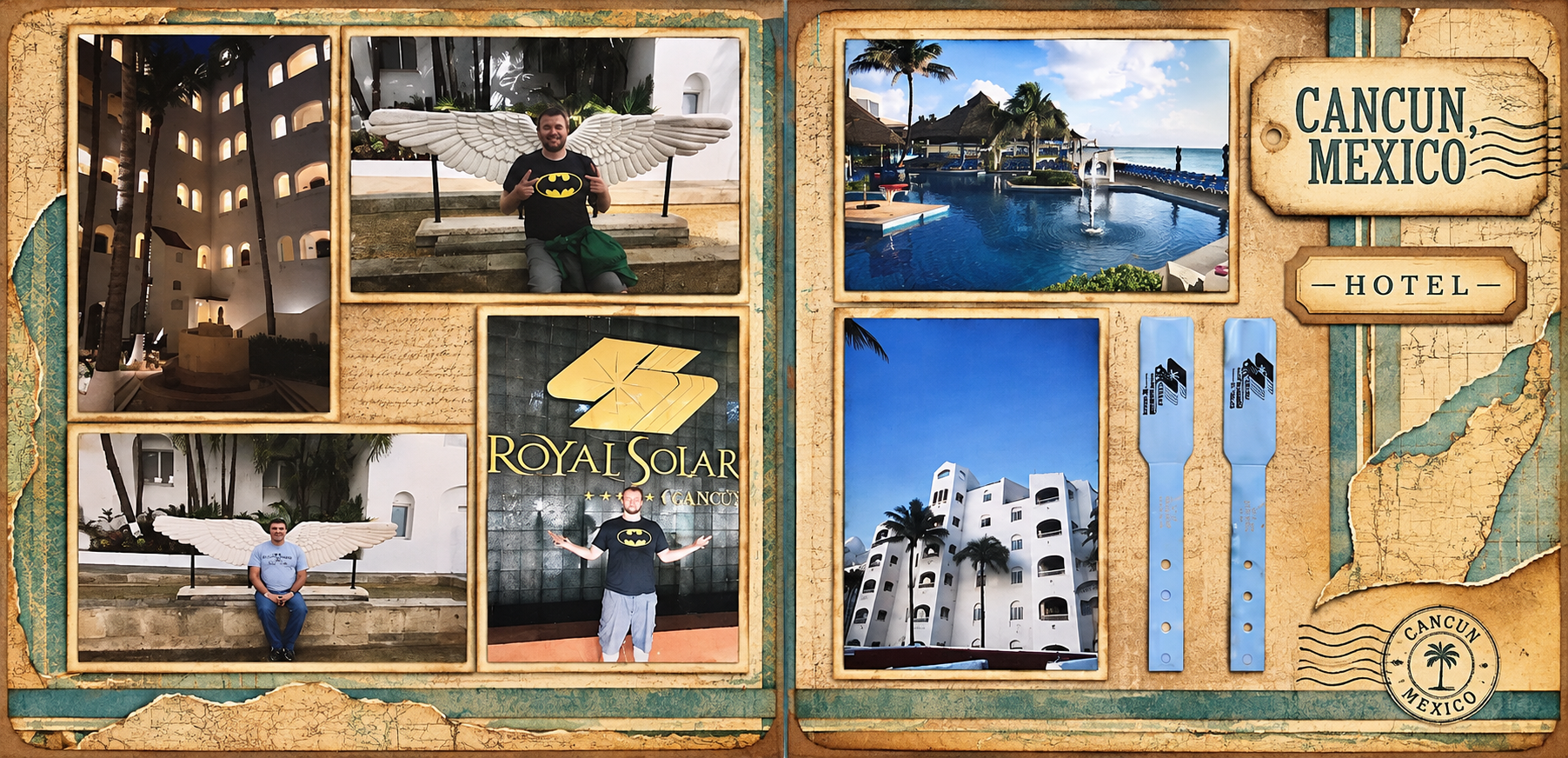
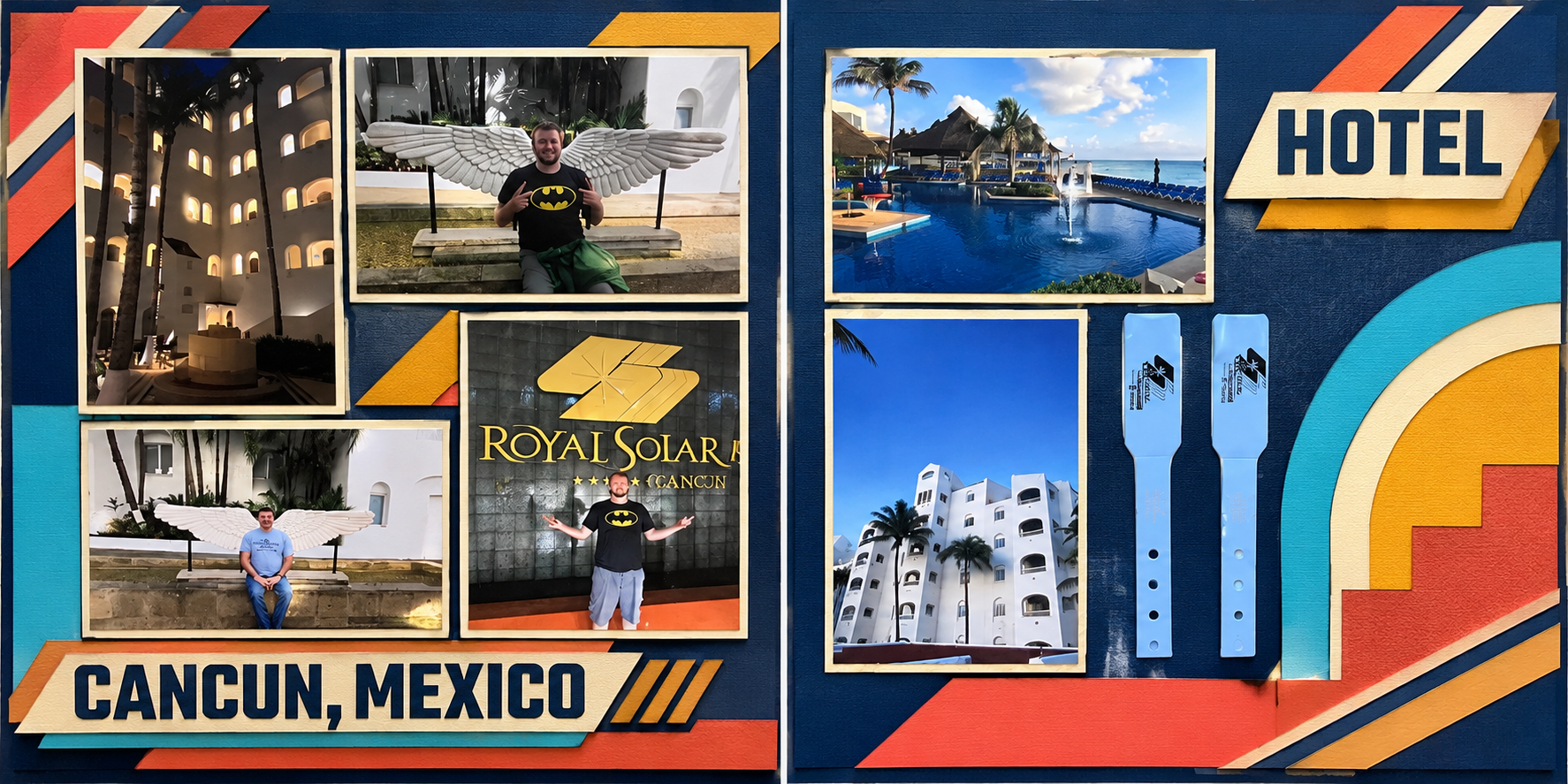
As you can see ChatGPT has warped the faces a bit – but that is not what is important – It kept my photos in the correct places and designed around them.
And there’s a practical consideration worth mentioning. If you’re using someone else’s scrapbook design as inspiration, it’s important to respect their creative work. For this exercise, I used one of my own layouts or a design. The goal is to explore design techniques, not to reproduce someone else’s work without acknowledgment.
Creating Each Scrapbook Spread as Something Unique
One thing I want to emphasize is that I don’t approach masculine scrapbooking with a fixed collection of embellishments that I use over and over. I generally create each scrapbook spread from scratch.
The photographs, destination, event, and story determine what kinds of design elements might work. A scrapbook page about a historic building may call for architectural shapes or a silhouette of the landmark. A cruise spread might incorporate waves, a ship, or a route map. A page about a family celebration might take an entirely different direction. I enjoy that variety.
While I certainly have colors, techniques, and design approaches that I return to, I don’t want every page to look like a variation of the one before it. That’s one reason I find ChatGPT useful. It can help me explore new ideas for each project without requiring me to rely on the same embellishments or decorative formulas.
It also helps me get beyond the limitations of what happens to be available in a craft store or an online design library. If I have a particular idea in mind, I can describe it, ask ChatGPT to visualize it, and continue refining the result until I have something that fits the project. Of course, not every AI-generated design will be practical to make. Some may be too intricate for cardstock cutting, while others may simply not fit the style I’m trying to create.
But even when I don’t use the suggested design, the process can help me discover a direction I hadn’t considered.
In the next article in our AI in the Scrapbook Room series, Using ChatGPT to Help Write Scrapbook Journaling, we’ll shift our attention from visual design to storytelling and explore how AI can help us put our memories into words without losing our personal voice.
Watch the Complete Tutorial
In the accompanying video, I’ll demonstrate the three techniques we’ve explored in this article: finding alternatives to traditional scrapbook embellishments, comparing different masculine design aesthetics, and transforming an existing scrapbook layout.
You’ll see the actual prompts, the visual results, and how I refine ChatGPT’s suggestions to better fit my design preferences.
The video includes chapters corresponding to the three steps above, so you can watch the entire demonstration or pause at each stage to experiment with your own scrapbook projects.
Categories: AI Tips and Tricks, Articles

