
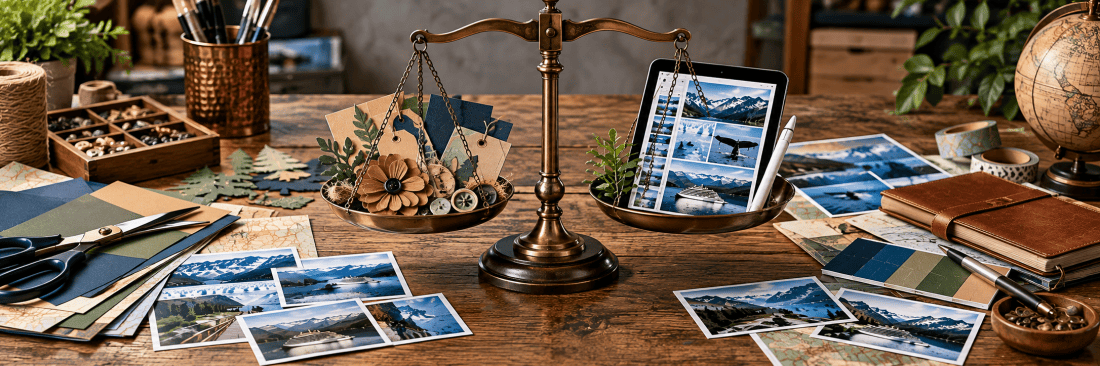
The AI Dilemma: Balancing Creativity, Ethics, and Technology in Scrapbooking
AI in the Scrapbook Room: Article 3
In the first two articles of this series, I’ve shared how I began experimenting with ChatGPT for scrapbooking and explored some of the ways artificial intelligence can help us with our creative projects. As you can probably tell, I’ve become rather enthusiastic about the possibilities. I’ve been amazed by some of the graphics I’ve been able to create, the design problems I’ve been able to work through, and the ways AI has helped me think about my scrapbook pages differently.
But I also recognize that artificial intelligence raises some important questions, and not all of them have comfortable answers.
I use AI extensively in my professional work and for a variety of personal projects, so I’ve had plenty of opportunities to consider both its benefits and its limitations. While I enjoy exploring what this technology can do, I don’t think we should ignore the broader implications of using it.
In fact, I think there are some particularly interesting dilemmas when we consider AI in the context of scrapbooking. After all, this is a hobby built around personal creativity, handmade artwork, preserving memories, and expressing ourselves through the things we create.
So, before we get too far into the practical tutorials in this series, I want to spend a little time exploring some of the questions I’ve been thinking about. I’m not going to pretend that I have all the answers, but I do think these are conversations worth having.
The Environmental Cost of Artificial Intelligence
Let’s begin with an issue that has received considerable attention recently: the environmental impact of AI.
Every time we use an AI program such as ChatGPT, our requests are processed by computers housed in large data centers. These facilities require substantial amounts of electricity to operate, and many also use water for cooling. Manufacturing the specialized computer equipment also requires energy and raw materials.
As AI becomes more widely used, the demand for computing power continues to grow, raising legitimate concerns about energy consumption, water resources, and the environmental consequences of building and operating these facilities.
What makes this complicated is that the environmental impact of an individual AI request is difficult to measure. Different systems require different amounts of computing power, and the energy and water involved depend on factors such as the location of the data center, its cooling system, and the source of its electricity. Generating images can also require considerably more computing resources than producing a short text response.
For those of us using AI as part of a hobby, this raises an interesting question. Is the creative benefit we receive worth the resources required to produce it?
Of course, scrapbooking itself has an environmental footprint. We purchase cardstock, adhesives, plastic embellishments, electronic cutting machines, and other supplies. Many of these products require manufacturing, packaging, and transportation, and some eventually become waste.
That doesn’t mean we should dismiss the environmental concerns surrounding AI simply because other aspects of our hobby also consume resources. Instead, I think it reminds us that nearly every creative activity involves choices about how we use materials and technology.
For me, the important thing is to remain aware of those choices rather than assume that something digital has no environmental cost.
What About the Artists Who Create Our Scrapbooking Supplies?
This is one of the questions I find particularly challenging.
Over the years, I’ve purchased countless embellishments, stickers, patterned papers, and other scrapbook supplies. Behind many of those products are talented artists and designers who have invested considerable time developing their skills and creating original artwork.
Now, with AI, I can describe a graphic I want and potentially generate something similar to what I might otherwise have purchased.
That raises an obvious concern: If more scrapbookers begin creating their own AI-generated graphics, what happens to the people who make their living designing scrapbook products? I don’t think there is a simple answer.
On one hand, technology has always changed the way we approach creative hobbies. Electronic cutting machines made it possible for scrapbookers to create their own titles and embellishments rather than purchasing everything premade. Digital photography transformed how we take, print, and preserve photographs. Home printers, design software, and online resources have all expanded what individual scrapbookers can accomplish.
AI may be another development in that progression, but it also introduces some important differences.
An electronic cutting machine still requires someone to create or select a design. AI can generate new artwork in response to a description, potentially reducing the need to purchase designs from professional artists.
I certainly don’t want to see independent artists and scrapbook designers disappear because their work is being replaced by inexpensive, AI-generated alternatives. At the same time, I enjoy the ability to create something highly specific for a particular scrapbook page, especially when I cannot find an existing embellishment that meets my needs.
For now, my approach is to continue purchasing traditional scrapbook supplies and supporting artists while also experimenting with AI for custom designs. I don’t see these activities as mutually exclusive, although I recognize that the balance may become more complicated as the technology improves.
Copyright, Artistic Ownership, and How AI Learns
Closely related to the concerns about artists is the question of how artificial intelligence systems are developed.
AI image generators are trained using enormous collections of images and other information. Depending on the system, some of those materials may include copyrighted artwork created by photographers, illustrators, designers, and other artists. This has led to considerable controversy over whether creators should have been asked for permission before their work was used, whether they should receive compensation, and how copyright laws apply to AI-generated images. These questions are being debated in courts, legislatures, and creative communities around the world.
For scrapbookers, the issue becomes particularly relevant when we ask AI to create artwork. Suppose I request a graphic of a tropical island, an old-fashioned automobile, or a historic building. The resulting image may be newly generated, but the system’s ability to produce it comes from patterns learned during training. That raises questions about the relationship between the original works used in training and the new images being produced.
There is also a difference between asking AI to create an original design based on a general description and asking it to reproduce the distinctive work of a particular artist. Personally, I would rather describe the elements, colors, and composition I want than ask AI to imitate a living artist’s recognizable style.
Another consideration is that AI-generated artwork does not always receive the same copyright protections as artwork created by a human. The rules vary by country, and in the United States, copyright protection generally depends on the extent of human authorship involved.
For someone creating a personal scrapbook, these legal questions may not seem particularly urgent. However, they become more important if we begin selling AI-assisted designs, sharing downloadable graphics, or incorporating them into commercial products.
I think the most responsible approach is to recognize that these issues remain unsettled and to be thoughtful about the kinds of artwork we ask AI to create.
Is It Still Handmade If AI Helps Create It?
This may be the question most directly connected to scrapbooking itself.
If I use ChatGPT to create an embellishment, print it, cut it with my Cricut, and incorporate it into a scrapbook page, is the finished page still handmade? My answer is yes, although I understand why others might disagree.
Think about the materials we already use in scrapbooking. Most of us purchase commercially printed patterned paper, stickers, die cuts, and other embellishments. We use electronic cutting machines to produce precise shapes and lettering. We may even purchase complete scrapbook kits that include coordinated papers, embellishments, and suggested layouts. Yet we still consider the finished scrapbook pages to be our own creative work.
Why? Because we are the ones making decisions about which photographs to include, how to arrange them, what stories to tell, and how the different elements come together.
I see AI-generated graphics in much the same way. When I use ChatGPT to help create an embellishment, I usually have a specific idea in mind. I describe what I want, review the result, identify what needs to change, and continue refining the design until it works for my page.
Sometimes this involves quite a few attempts, and occasionally I abandon an idea altogether because the results simply aren’t what I envisioned. The creative decisions remain mine, even though I am using technology to help produce some of the elements.
That said, I also recognize that there is a difference between creating something entirely by hand and using AI to generate artwork. I don’t think we need to pretend those processes are identical.
Perhaps the more important question is whether we are being honest about how our projects are created and whether the finished work reflects our own creative intentions.
For me, the value of a scrapbook page has never been determined solely by how much of it was made by hand. It comes from the memories it preserves and the care taken in telling those stories.
Could AI Make Us Less Creative?
Here is another concern that I think deserves serious consideration. If we become accustomed to asking AI for layout ideas, color combinations, titles, and embellishments, could we gradually lose some of our own creative abilities? It’s certainly possible.
Creativity involves experimenting, making mistakes, solving problems, and occasionally struggling through an idea until we discover something that works. Those experiences help us develop our artistic judgment and personal style. If we immediately turn to AI whenever we encounter a challenge, we might miss opportunities to develop those skills ourselves.
I think about this when I’m working on a difficult scrapbook layout. Sometimes the process of moving photographs around, trying different arrangements, and experimenting with papers is exactly what makes the experience enjoyable. I wouldn’t want to lose that.
On the other hand, I have also found that AI can stimulate creativity rather than diminish it. Sometimes ChatGPT suggests an approach I hadn’t considered. I may not use the suggestion exactly as presented, but it can inspire another idea that becomes the basis for my design. In those situations, AI isn’t replacing my creative thinking. It’s giving me something new to react to.
I suspect the difference comes down to how we choose to use the technology. If we allow AI to make every decision, we may become less engaged in the creative process. But if we use it to explore possibilities, challenge our assumptions, and experiment with new approaches, it may actually help us become more creative.
That’s the balance I hope to maintain.
Making Creativity More Accessible
While there are legitimate concerns about AI, I also think we need to recognize the opportunities it creates.
Not everyone has the same artistic abilities, technical skills, physical capabilities, or access to creative resources. Some scrapbookers are excellent at arranging photographs but struggle with drawing. Others enjoy journaling but find it difficult to design embellishments. Some may have physical limitations that make certain techniques challenging. AI can help reduce some of those barriers.
Someone who cannot draw a particular image may be able to describe it and generate a useful graphic. A scrapbooker who struggles with writing may find it easier to dictate memories and receive help organizing them into a story. Someone who feels intimidated by complicated design software may discover that describing an idea conversationally is a more comfortable way to begin. I think this is particularly important in a hobby that attracts people with such a wide range of backgrounds and experiences. We don’t all need to possess the same skills to create meaningful scrapbook pages.
AI may also make it easier for scrapbookers to develop highly personalized designs that would otherwise require expensive software, specialized training, or commissioned artwork.
Of course, access to AI isn’t entirely equal either. Reliable internet connections, suitable devices, digital literacy, and the cost of paid subscriptions can all create barriers.
Nevertheless, I believe the potential to make certain creative activities more accessible is one of the more positive aspects of this technology.
Finding a Responsible Balance
So, where does all of this leave us?
I enjoy using AI, and I expect it will continue to play a role in my scrapbooking. I’ve already discovered ways it can help me create custom embellishments, explore design possibilities, and solve problems that might otherwise take considerably more time. But I don’t want my enthusiasm to prevent me from recognizing the legitimate concerns surrounding the technology. I think we can appreciate the possibilities of AI while also being thoughtful about how we use it.
For me, that means continuing to support traditional scrapbook artists and suppliers, being mindful of the environmental resources involved, respecting the work of other creators, and making sure that AI remains a tool rather than the driving force behind my creativity.
It also means being transparent about my process. If I use ChatGPT to help create a graphic or develop a design, I have no reason to hide that fact. In this series, I intend to show exactly how I use the technology, including the successes, failures, and occasional frustrations.
I also think it is important to recognize that not everyone will feel comfortable using AI, and that is perfectly reasonable. Scrapbooking is a deeply personal hobby. Some people love experimenting with new technology, while others find tremendous satisfaction in traditional techniques. Neither approach is inherently better. There is room for both.
A Conversation Worth Continuing
One of the reasons I wanted to include this article early in the AI in the Scrapbook Room series is that I don’t want to present artificial intelligence as though it is an entirely positive development without any complications. The reality is much more nuanced.
AI offers some remarkable creative possibilities, but it also raises questions about environmental responsibility, artistic ownership, employment, authenticity, and the role of technology in our lives. These are not questions that scrapbookers can resolve on our own, and I certainly don’t claim to have definitive answers. What I do believe is that we should be willing to have the conversation.
As I continue experimenting with ChatGPT, I expect my understanding of both its benefits and its challenges will evolve. There may be things I am comfortable doing today that I reconsider later, just as there may be new applications that I haven’t even imagined yet. For now, I intend to approach AI with curiosity, enthusiasm, and a healthy amount of skepticism.
In the next article, we’ll return to the creative side of this discussion and explore how AI can expand our creativity without replacing the personal decisions that make our scrapbook pages uniquely ours.
In the meantime, I’d be interested to hear what you think. Have you experimented with AI in your own creative projects? Do you have concerns about its use, or have you discovered benefits that surprised you?
I suspect there are many different perspectives among scrapbookers, and I think those perspectives are worth sharing.
After all, the purpose of scrapbooking has always been to preserve the stories and experiences that matter to us. Whatever tools we choose to use, I hope that remains at the heart of what we create.
Categories: AI Tips and Tricks, Articles

