
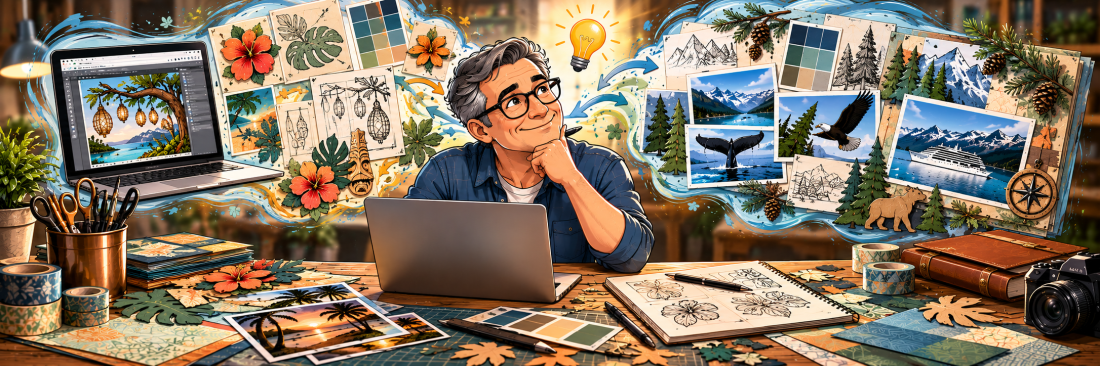
Making Room for AI in My Scrapbooking Process
AI in the Scrapbook Room: Article 4
In my previous article, I explored some of the ethical questions and concerns surrounding artificial intelligence, particularly when it comes to creative hobbies like scrapbooking. Those are important conversations, and I think we should continue having them as AI becomes more integrated into our lives. Today, however, I want to focus on something that has become increasingly clear to me as I’ve experimented with ChatGPT: Artificial intelligence doesn’t have to replace our creativity. In fact, when used thoughtfully, I find that I have become more creative.
When I first started experimenting with AI for scrapbooking during my Alaska cruise, I wasn’t looking for something to design my pages for me. I was simply curious whether it could help me develop some ideas I already had in mind. What I discovered was an unexpected way to work through the design process. Since then, I’ve experimented with different graphics and techniques. Some have worked beautifully, while others have required considerable patience. There have even been a few occasions when I’ve wondered whether ChatGPT and I were looking at the same picture!
Creativity Still Begins with You
One of the things I enjoy most about scrapbooking is that every page begins with a story I want to preserve. Sometimes it is a family vacation, a special event, or an ordinary moment that I don’t want to forget. The photographs and memorabilia provide the starting point, but the decisions about how to tell that story are personal. AI doesn’t know why I selected a particular photograph, why a certain color reminds me of an event, or why I want to include an unusual piece of memorabilia on a page.
When I use ChatGPT, I begin by explaining what I am trying to accomplish. I might describe the photographs I want to use, the space available on a page, the colors I have selected, or a particular embellishment I would like to create. The more clearly I communicate my intentions, the more useful the results become.
For example, when I was developing embellishments for my Hawaiian scrapbook pages, I needed graphics that reflected the experiences we had enjoyed while also fitting into particular spaces on my layouts. ChatGPT could generate possible designs, but I had to determine which ones would work with my photographs, papers, and overall arrangement.
Having Someone to Bounce Ideas Off
Have you ever been working on a scrapbook page and wished you had someone nearby to ask for an opinion? Perhaps you’re trying to decide between two color combinations, struggling with the arrangement of photographs, or wondering whether an embellishment would look better on the left or right side of a page.
I can describe what I’m working on, explain what isn’t quite right, and ask ChatGPT for suggestions. Sometimes it offers an idea that works immediately. Other times, it suggests something I don’t particularly like, but that suggestion leads me to think of an alternative. Either way, the conversation can help me clarify what I actually want.
And unlike asking another person for advice, I don’t have to worry about wearing out ChatGPT’s patience when I ask it to try something for the tenth time! Of course, there are plenty of occasions when I decide that my original idea was better.
Experimenting Without Wasting Supplies
Anyone who has spent much time scrapbooking knows that experimenting can sometimes become expensive. Cardstock, patterned papers, specialty materials, and embellishments all cost money. While I don’t mind using supplies to create something meaningful, I would rather avoid cutting several pieces of cardstock only to discover that the design doesn’t work.
Before committing to a particular design, I can test its appearance digitally. If I’m considering an embellishment, for example, I can examine its shape, proportions, and placement before cutting anything. This doesn’t eliminate the need to test designs with actual materials. A graphic that looks wonderful on a computer screen may not translate perfectly into layered cardstock, especially when it contains small details or complicated shapes. However, it can help me identify potential problems before I begin cutting. I also use Cricut Design Space to experiment with layouts and create photo mats, so this fits naturally into my existing planning process.
Moving Beyond Our Creative Comfort Zones
I suspect most scrapbookers develop certain preferences over time. We have colors we naturally gravitate toward, arrangements we enjoy using, and embellishments that fit our personal style. There is nothing wrong with that. In fact, those preferences are part of what makes our scrapbook pages recognizable as our own work. But sometimes our familiar approaches can also limit what we consider.
I tend to favor a masculine scrapbooking style, often incorporating architectural elements, travel imagery, geometric shapes, and other designs that complement my photographs. When I ask ChatGPT to suggest variations, it occasionally introduces combinations or approaches I wouldn’t have selected myself.
I don’t necessarily use every suggestion. Sometimes an unfamiliar approach confirms that my original idea was the better choice. Other times, it encourages me to try something different while still maintaining my personal style.
The First Result Is Rarely the Final Design
If there is one lesson I’ve learned from experimenting with AI-generated scrapbook graphics, it is that patience is essential. It’s tempting to imagine that you can simply describe what you want, press a button, and receive a perfect graphic. Occasionally, something close to that happens. More often, however, the process involves several rounds of adjustments.
A good example is a graphic I was creating for one of my Hawaiian scrapbook layouts. I wanted an old tree with irregular branches extending across the upper portion of the page, with woven lanterns hanging from some of the branches. The tree needed to fit within a very specific area, with the trunk along the right side and the branches extending toward the left without taking up too much space in the middle. That sounds fairly straightforward, doesn’t it? Well, it took quite a few attempts!
Sometimes the branches extended too far into the page. Other times they didn’t extend far enough. I also wanted the lanterns to have openings in the weaving so that the background of the scrapbook page would show through. Each time ChatGPT generated a new version, I examined it and explained what needed to change. Eventually, we developed something much closer to what I had envisioned.
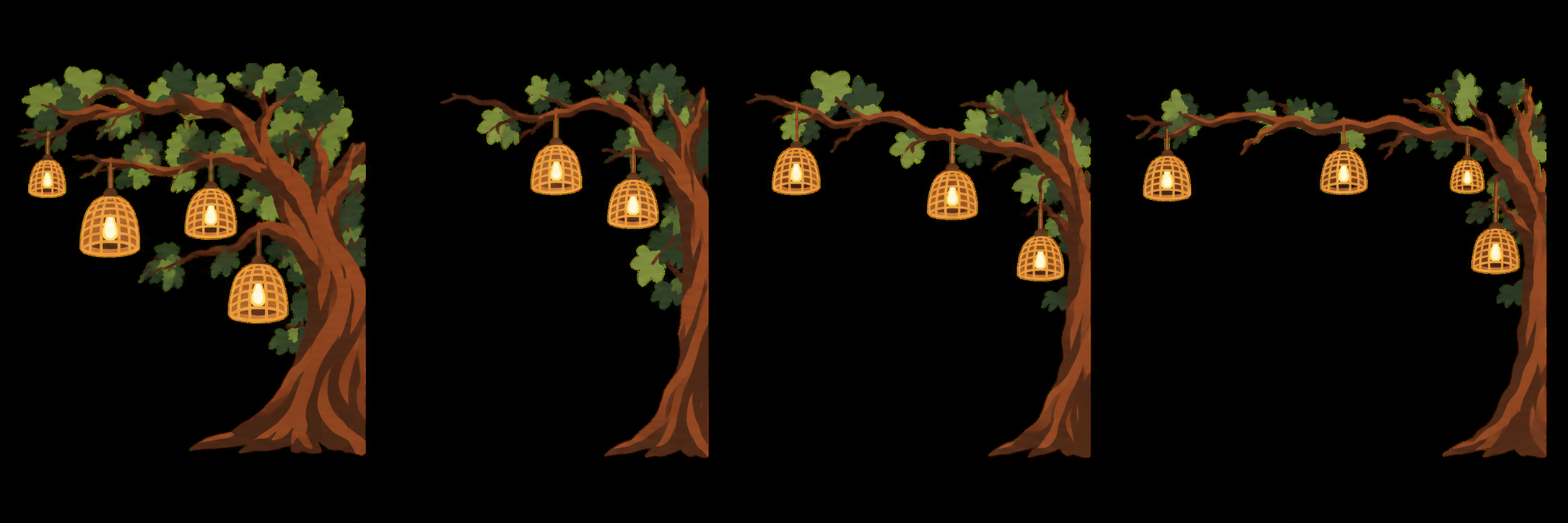
What I find interesting about this process is how much of the work happens during the revisions. I have to evaluate the design, identify problems, and communicate the adjustments clearly. Sometimes, despite all those revisions, AI simply doesn’t produce what I want. When that happens, I either change my approach or move on to something else. In the example above I realized that the pattern on the lanterns was going to be too small to cut and so I just opted for solid yellow lanterns.
The Finished Scrapbook Page Is Still Yours
A scrapbook page is much more than the individual materials used to create it. We purchase patterned papers designed by other people, use commercially produced stickers and die cuts, and rely on cameras, printers, cutting machines, and software to help produce the elements we incorporate into our pages.
I see AI-generated graphics as another possible component of that process. If I ask ChatGPT to create a particular embellishment, refine it to fit my design, cut it from cardstock, and incorporate it into a layout alongside my photographs and memorabilia, I still consider the finished page to be my creation. The memories, the story, and the decisions about how everything comes together are mine.
I recognize that other scrapbookers may feel differently. Some people find the greatest satisfaction in creating every element by hand, while others enjoy working with commercially produced supplies or digital tools. There is room for all of those approaches, and I don’t think we need to agree on a single definition of what makes a scrapbook page meaningful.
Another Tool in the Scrapbooking Toolbox
When I think about how my scrapbooking has evolved over the years, I realize that I’ve incorporated quite a few new tools and techniques along the way. Digital photography changed how I capture and print photographs. Electronic cutting machines expanded the kinds of titles and embellishments I could create. Design software made it easier to experiment with layouts before committing to paper.
I’m beginning to think of AI in much the same way. It is another addition to the tools I use, with its own strengths, limitations, and occasional frustrations. What interests me most is the opportunity to attempt designs that might previously have been too difficult, time-consuming, or beyond my technical skills.
As we continue this series, I’ll share practical examples of how I use ChatGPT, including the prompts I use, the results I receive, and the adjustments I make along the way. In our next article, we’ll move from discussing the possibilities to actually trying some of them. I’ll share ten introductory ChatGPT prompts that you can use to begin experimenting with your own scrapbook projects.
Whether you’re curious about AI or still a little skeptical, I hope you’ll give some of these ideas a try. You might discover a few new ways to bring your scrapbook ideas to life.
Categories: AI Tips and Tricks, Articles

